The Best Card Games for Two Players (Pâsur Makes the List)
The best 2 player card games, honestly compared. Cribbage, Gin Rummy, Schnapsen, Briscola, Cassino, Spite & Malice, two-handed Pinochle, and Pâsur — what each one does well.
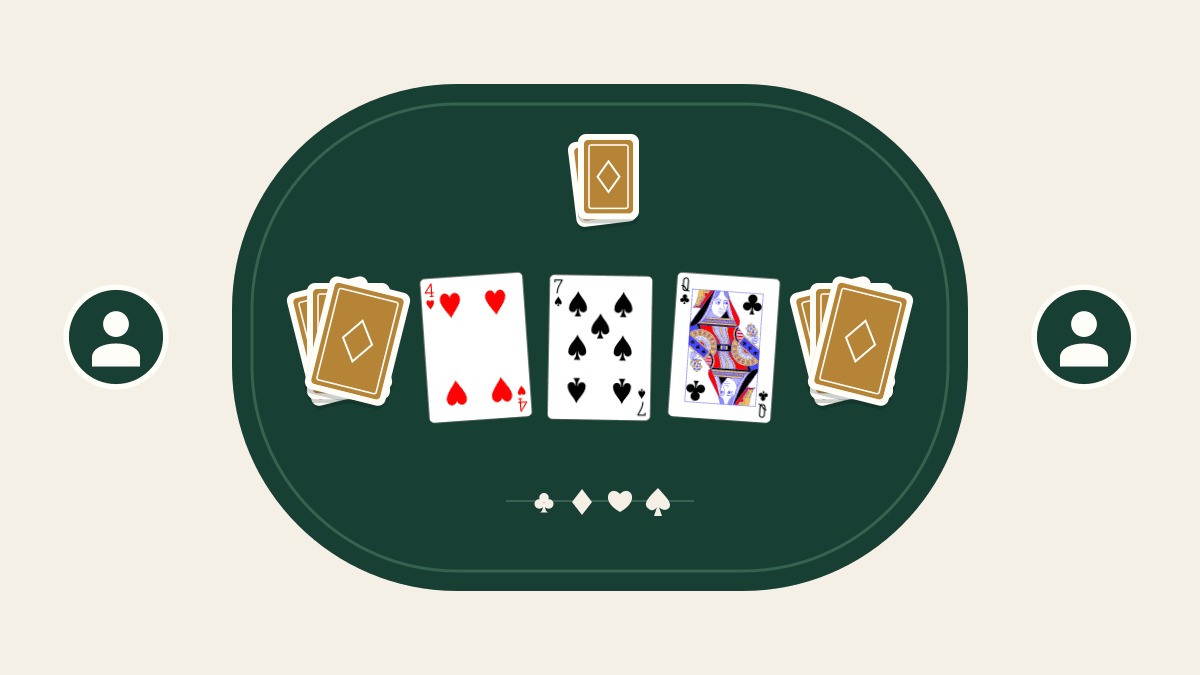
For two players, start with Gin Rummy for matching sets, Briscola for a short trump game, or Pâsur for capturing cards from a shared table. Cribbage, Schnapsen, and Cassino reward repeated play with the same person. Spite and Malice and Pinochle need more than one ordinary deck.
These eight games offer different kinds of decisions, from holding a useful card to planning a capture several turns ahead. Pâsur (پاسور), the Persian game we build, is one of the choices. This guide covers two-player versions; if your group is larger, use the card games by player count guide.
Compare the eight games
Times are approximate planning estimates for players who know the rules, not measured averages. Teaching and close scores can make a session longer; the table distinguishes a single deal from a full match.
| Game | Equipment | Learning difficulty | Approximate time | Best fit |
|---|---|---|---|---|
| Gin Rummy | One 52-card deck; paper for scores | Easy to start | 30–45 min, match to 100 | Conversation and matching sets |
| Briscola | 40 cards: remove 8s, 9s, 10s from one deck | Easy | 10–15 min, one deal | A short game with a trump suit |
| Schnapsen | 20 cards: A, 10, K, Q, J of each suit | Demanding | 20–40 min, match | Counting and compact tactical play |
| Cribbage | One 52-card deck; board or paper for scores | Moderate | 30–45 min, match to 121 | A regular rivalry and combination scoring |
| Spite and Malice | Two 52-card decks; space for piles | Easy to moderate | 20–40 min, one game | A race to empty your personal pile |
| Pâsur | One 52-card deck; paper for scores | Easy to start | 30–45 min, match to 62 | Shared-table tactics and teaching a family game |
| Cassino | One 52-card deck; paper for scores | Moderate | 30–60 min, match | Planning and stealing builds |
| Two-Handed Pinochle | 48-card Pinochle pack, or selected cards from two decks | Demanding | 45–90 min, match to 1,000 | Learning a detailed game together |
Play Pâsur offers Pâsur only, not the other seven games. Its learning pages and tutorial are available in English and Farsi; the game interface is currently English.
1. Gin Rummy
Setup: one 52-card deck, 10 cards each. Form melds: runs of at least three cards in one suit or sets of matching ranks. You may knock with unmatched cards totaling 10 or less. After laying off, an opponent with equal or lower unmatched value undercuts the knocker. Bicycle's Gin Rummy rules explain the scoring; agree on a bonus schedule before starting, since published versions differ.
Gin rewards memory: which cards did your opponent pick up, and which did they discard? The recurring choice is whether to knock now or wait for gin, a hand with no unmatched cards. A match to 100 leaves room to recover from a poor deal.
The drawback: luck plays a meaningful role, especially in single-hand outcomes. The right melds can fall into your lap or refuse to. Over a long match it evens out, but a single hand of Gin is rarely decided on skill alone.
Best for: new card-game players, the first time you sit down with someone, casual evenings where conversation matters more than strategy.
2. Briscola
Use a 40-card Italian deck, or remove every 8, 9, and 10 from a 52-card deck. Deal three cards each and expose a card to set trump. After each trick, draw one card each, winner first, while stock remains.
You do not have to follow suit. The highest trump wins; without trump, the highest card of the led suit wins. With French-suited cards, ranks are A, 3, K, Q, J, 7, 6, 5, 4, 2; their points are 11, 10, 4, 3, 2, then zero. More than 60 of the available 120 points wins; 60–60 ties. The Valliadi Briscola rules confirm the free choice of suit and scoring.
The drawback: very few rules, but the strategy is pure card-counting and trump management. Casual players sometimes play it without thinking and get bored. It rewards the patient.
Best for: an espresso break with a friend, learning the trump game family, or as a warm-up to Schnapsen.
3. Schnapsen
This is 20-card Schnapsen, not 24-card Sixty-Six: keep A, 10, K, Q, J in each suit. Deal five cards each. Aim for 66 points from tricks and declared marriages.
With both King and Queen of one suit in hand, show the pair when leading and play one; a marriage is worth 20, or 40 in trump, once you have won a trick. The trump Jack, not a 9, can exchange for the exposed trump when you lead. Closing or exhausting the stock activates stricter suit-following and trick-winning requirements. See the Philos Schnapsen rules, pages 57–58.
The drawback: the smallest learning curve cliff on this list. The rules are short, but the interactions between rules — closing the stock, marriages, the trump exchange — are not intuitive. Plan to spend an hour learning before you start enjoying it.
Best for: dedicated two-player sessions, players who like compact games with deep strategy, anyone who's ever lost an evening to Cribbage and wants more.
4. Cribbage
The deepest classic two-player game in English, and one of the deepest period. Cribbage has been played continuously since at least the 1630s; it has its own scoring board (the cribbage board) with pegs you advance as you score. The board is the sales pitch — once you've played a few hands, you'll think of cribbage and the smell of polished wood together.
Setup: standard 52-card deck, deal 6 cards each. Each player discards 2 to a "crib" (the dealer's bonus pile). The non-dealer cuts, the dealer flips the top card of the deck as the starter. Then alternating play: you each lay down one card at a time, calling out a running total. The total may not exceed 31. You score points as you go for hitting various totals (15 = 2 points, 31 = 2 points, pairs = 2 points, runs = 1 per card in run, and so on).
After the play phase, you score your hand for combinations with the starter card: fifteens (every combination summing to 15 = 2 points), pairs, runs, flushes, the right Jack (jack of starter suit). The dealer also scores their crib at the end. First to 121 points wins. A board is convenient, but paper works too; keep a Cribbage scoring reference beside your first game.
The drawback: the rules require memorization. Until you've internalized the scoring patterns, you'll miss points and feel unfairly behind. There's no shortcut — playing 5 hands with a more experienced opponent and a printed scoring guide is the standard onboarding.
Best for: committed two-player matchups, evenings with a hot drink, anyone who likes the feel of pegs in their hand.
5. Spite and Malice
A sequence-building race using two 52-card decks. In the SpiteNET house version, deal each player a 20-card payoff pile and five cards in hand. Race to empty your payoff pile onto three shared center piles, building from Ace through Queen with Kings wild. You can also play the top card of a discard pile. Refill your hand to five at the start of your turn; a discard ends the turn.
Agree on a version first: payoff size, number of center piles, and wild-card restrictions vary. Skip-Bo is a related commercial game with its own pack and rules, so do not combine the two rulebooks halfway through a game. Watching the opponent's exposed payoff card makes blocking as important as advancing your own pile.
The drawback: repetition. Games can feel samey because the central mechanic doesn't shift much round-to-round. Also: it's hard to play with one regular deck — you really do need 104 cards.
Best for: afternoons when you want a game with light strategy and a clear end state, players who like patience-style games but want competition.
6. Pâsur
Now for the home team. Pâsur is the household card game of Iran — covered in detail in the complete visual guide. In two-player play it's one of the most aggressive games on this list. Each player gets 4 cards, with 4 face-up in a central pool. You capture pool cards by playing a hand card whose value sums to 11 with one or more pool cards (Ace = 1, face cards have separate rules). Kings capture Kings, Queens capture Queens, and Jacks are wild — sweep every non-K/Q card on the table.
The signature tension is Sur cancellation. A Sur is a 5-point bonus for clearing the pool with a non-Jack capture, except during the final deal. If your opponent has a pending Sur, your next Sur cancels one of theirs instead of adding one to your score. The Sur guide with card examples explains which clears count.
End-of-round scoring gives 7 points for Haft Khâj (at least seven clubs), 3 for the 10♦, 2 for the 2♣, 1 each for Aces and Jacks, and 5 for each net Sur. First to 62 wins. Keep the scoring guide and printable scorecard beside a physical game.
The drawback: only one. The cultural specificity is a feature for some, a friction for others. The Persian terms (Bibi for Queen, Sarbâz for Jack, Sur for sweep — all in the glossary) add color but require a footnote for every non-Iranian player. Once those are absorbed, the game itself plays cleanly with anyone.
Best for: people who already play other fishing games (Scopa, Cassino) and want a Persian variant; anyone who likes high-leverage mechanics (the wild Jack, sur cancellation) over slow accumulation; the Iranian diaspora and friends-of-the-diaspora teaching the game across generations.
Try five guided hands in the interactive Pâsur tutorial, then practice against the computer or invite someone from the homepage. Friend games can continue one turn at a time when your schedules do not line up.
7. Cassino
The English fishing game, and the most strategically deep card game on this list once you reach a certain level. Cassino looks similar to Pâsur on the surface — pool of face-up cards, capture from your hand — but its mechanics are wildly different.
The capture rule: number cards capture by rank match (play a 7, take a 7) or by summing (play an 8, take a 3+5). Face cards pair by rank only.
The defining trick is builds. You can lay a card from your hand onto a pool card and announce a total. That combined card is now treated as a single card of that value, waiting to be captured by you on a future turn (you must already hold the capturing card when you build). Your opponent can steal your build if they hold the matching card. Builds can be extended ("building eight, now nine"), paired with other builds, and combined into multi-build constructs.
Cassino is the closest a card game gets to chess. You're planning three or four turns ahead, holding cards strategically, denying the opponent's builds. Master-level Cassino is genuinely deep — see the Wikipedia entry for the full structural rules.
Scoring at round-end: most cards (3 points), most spades (1), Big Cassino — the 10♦ (2 points), Little Cassino — the 2♠ (1 point), each Ace (1), each sweep (1).
The drawback: the build rule is the hardest single rule on this entire list to teach. Until both players are fluent with builds, the game is one-sided. Plan for 2–3 onboarding games before it clicks.
Best for: the hour-long "real game" of an evening, people who like long-range planning, and anyone who's already mastered Pâsur or Scopa and wants the next level of complexity.
8. Two-Handed Pinochle
Use the classic two-player version published by Bicycle, which has no bidding. Its 48-card pack contains two copies of A, 10, K, Q, J, 9 in every suit; make one from two standard decks. Deal 12 cards each. Of the 24 cards left, expose one for trump and leave 23 face-down.
While stock remains, a trick winner may declare a scoring meld before both players draw; melding happens during play. When the stock runs out, play the remaining cards under stricter suit-following and trump rules. Score captured cards and melds. Play one deal or agree on a match to 1,000.
The drawback: the most rules of any game on this list. Onboarding is real. Even for experienced card players, the first 5 games of Pinochle feel like swimming in oatmeal. The reward is genuinely deep play once you cross that learning threshold.
Best for: committed two-player relationships (a long-running spousal rivalry, a chess-buddy who wants more variety), late-night card sessions where time isn't a factor, anyone who grew up watching grandparents play and wants to honor that.
How to choose
Some quick guidance based on the situation:
- You have 30 minutes: Gin Rummy or Briscola.
- You have a full evening: Cribbage, Pâsur, or Cassino.
- One of you is teaching the other: Gin Rummy first; Briscola second.
- You both already love card games: Schnapsen, Cassino, or Two-Handed Pinochle.
- You want something culturally specific: Pâsur (Persian), Briscola (Italian), Schnapsen (Austrian), Cassino (English).
- You're playing across a timezone (online, async): Pâsur with the online version — you can leave a game open for days. Spite & Malice also handles async play well.
A few honorable mentions I left off the main list:
- Scopa — the Italian fishing-game cousin of Pâsur. You can make its 40-card pack from a standard deck by removing 8s, 9s, and 10s. (Compared to Pâsur in detail.)
- Hearts — usually 4-player, but a two-handed variant exists. The 2-player Hearts feels gimmicky compared to the 4-player original; I'd just play something designed for two.
- Bezique — Pinochle's older European cousin. Beautiful game, vanishingly rare players. If you find one, treasure them.
- Egyptian Ratscrew — physical and silly. Great with kids. Not strategic.
A short word on the best of the best
Gun-to-head: if I could only keep three two-player card games for the rest of my life, they'd be Cribbage, Pâsur, and Schnapsen. Cribbage for the long-game tradition and the satisfying click of pegs. Schnapsen for the compact intensity. Pâsur because it's mine, in a deeper sense — it's the game I grew up watching played, and the one I now have the privilege of building software for. None of those three is replaceable by another.
Yours will be different, and that's the point. The right two-player card game is the one you and your specific person enjoy. Try a few. Most decks last a long time.
If you want to start with Pâsur tonight, the rules and visual walkthrough are both linked, and a live game at playpasur.com is about a minute away from your first deal.
Play Pasur
Put it into practice
Start a free solo game against the computer, or create an account and invite a friend to your table.
Keep learning
Card Games With a Standard Deck: Choose by Player Count
Choose a card game for one, two, three, four, or more players using a standard deck: compare setup, difficulty, time, and what each game asks you to do.
Pasur vs Scopa vs Cassino: Rules & Differences
Compare Pasur, Scopa, and Cassino rules side by side: decks, captures, sweeps, scoring, strategy, and which fishing card game to play first.
Persian Card Game Guide: Pasur, Hokm and Iranian Classics
Meet Pasur, Hokm, and Shelem, learn how the major Persian card games differ, and choose the right Iranian card game for your table.