A Full Pasur Deal, Move by Move
Follow a complete two-player Pasur round: all 48 moves across six deals, with card diagrams, captures, Sur cancellation, and a checked final score.
Pâsur makes more sense with cards on the table. Here is a complete two-player round: six deals, 48 moves, and the final score. You can follow it with a standard deck or pause after any turn to decide what you would play next.
This is an arranged teaching example, not a recording of a match or a claim that every choice is the strongest move. Both hands are shown so you can check every capture. In a real game, your opponent's hand is hidden.
If you want to try a few captures first, start the interactive Pasur tutorial. For a short reference beside this example, use the rules, scoring guide and scorecard, or Sur examples.
The rules you need at the table
You play one card per turn. A number card, counting Ace as 1, captures one chosen group of pool cards that adds to 11 together with it. A King takes one King; a Queen takes one Queen. A Jack takes every Ace, number card, and Jack in the pool, leaving Kings and Queens.
You may choose any card from your hand. If that card can capture, you must take a legal capture; otherwise it stays in the pool. You cannot choose to leave a capturing card behind. When you capture, your played card joins the cards you took in your captured pile.
Emptying the pool with a non-Jack capture earns a five-point Sur, except throughout the sixth and final deal. A new Sur cancels one of the opponent's pending Surs before it adds to your own. The last player to capture also receives any leftover pool cards at the end, without a Sur.
These are the two-player rules used by Play Pâsur. Families may use different Sur restrictions or scoring conventions, so agree on those before playing at a physical table.
Set up this round
Use all 52 cards, without Jokers. Your opponent deals and you play first in each of the six deals. Each player receives four cards per deal. Only the first deal adds four face-up cards to the pool; the initial stock therefore contains 40 cards. Later deals add eight cards to the hands and leave the pool as it is.
Starting pool: 4♣ 9♦ 3♥ K♠
In the tables, A is Ace, J is Jack, Q is Queen, and K is King. The suits are ♣ clubs, ♦ diamonds, ♥ hearts, and ♠ spades. A dash in the capture column means the card was left in the pool; a dash in the pool column means the pool is empty. The capture column lists only cards taken from the pool. Keep the played card too.
Deal 1: capture, trail, and earn a Sur
Your hand: 7♥ A♣ J♦ 6♠
Opponent's hand: 2♣ K♥ 5♣ 5♠
| Turn | Card played | Taken from pool | Pool after play |
|---|---|---|---|
| 1 | You: 7♥ | 4♣ | 9♦ 3♥ K♠ |
| 2 | Opponent: 2♣ | 9♦ | 3♥ K♠ |
| 3 | You: A♣ | — | 3♥ K♠ A♣ |
| 4 | Opponent: K♥ | K♠ | 3♥ A♣ |
| 5 | You: J♦ | 3♥ A♣ | — |
| 6 | Opponent: 5♣ | — | 5♣ |
| 7 | You: 6♠ | 5♣ | — |
| 8 | Opponent: 5♠ | — | 5♠ |
The opening 7 + 4 makes 11. On turn 3, your Ace needs pool cards totaling 10; neither the 3 nor the King can supply that, so the Ace stays. Your Jack recovers it on turn 5. That empties the pool but earns no Sur, because it is a Jack.
On turn 7, 6 + 5 makes 11 and leaves nothing. This time you earn a Sur. The 5♣ also joins your club count. Pending Surs after deal 1: you 1, opponent 0. The 5♠ remains for the next deal.
Deal 2: Surs can cancel, and face cards can earn them
Your hand: 2♥ Q♦ K♣ 7♦
Opponent's hand: 4♦ Q♠ K♦ 3♣
| Turn | Card played | Taken from pool | Pool after play |
|---|---|---|---|
| 9 | You: 2♥ | — | 5♠ 2♥ |
| 10 | Opponent: 4♦ | 5♠ 2♥ | — |
| 11 | You: Q♦ | — | Q♦ |
| 12 | Opponent: Q♠ | Q♦ | — |
| 13 | You: K♣ | — | K♣ |
| 14 | Opponent: K♦ | K♣ | — |
| 15 | You: 7♦ | — | 7♦ |
| 16 | Opponent: 3♣ | — | 7♦ 3♣ |
Turn 10 combines three values: 4 + 5 + 2 = 11. The opponent's Sur cancels yours, leaving both players at zero. Turns 12 and 14 each clear a one-card pool with a matching face card, so each earns the opponent a Sur. Playing a Queen or King onto an empty pool can expose you to exactly this reply.
On turn 16, 3 + 7 is only 10, so the 3♣ stays. Pending Surs after deal 2: you 0, opponent 2.
Deal 3: combine cards to recover a Sur
Your hand: A♥ 10♦ 2♦ 8♣
Opponent's hand: 4♥ 9♣ 6♣ Q♥
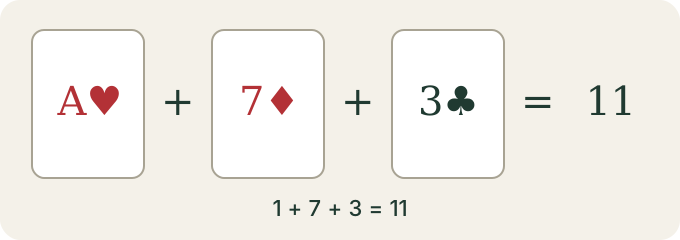
The diagram shows turn 17. Your Ace takes both pool cards because 1 + 7 + 3 = 11. You keep all three cards and empty the pool, canceling one opposing Sur.
| Turn | Card played | Taken from pool | Pool after play |
|---|---|---|---|
| 17 | You: A♥ | 7♦ 3♣ | — |
| 18 | Opponent: 4♥ | — | 4♥ |
| 19 | You: 10♦ | — | 4♥ 10♦ |
| 20 | Opponent: 9♣ | — | 4♥ 10♦ 9♣ |
| 21 | You: 2♦ | 9♣ | 4♥ 10♦ |
| 22 | Opponent: 6♣ | — | 4♥ 10♦ 6♣ |
| 23 | You: 8♣ | — | 4♥ 10♦ 6♣ 8♣ |
| 24 | Opponent: Q♥ | — | 4♥ 10♦ 6♣ 8♣ Q♥ |
Turn 21 secures the 9♣, another club toward Haft Khâj. Notice the risk on turn 19: the 10♦, worth three points, is left on the table. It needs an Ace to capture it, or it could be swept by a Jack. You do not know which cards the next deal will bring during a real game.
Pending Surs after deal 3: you 0, opponent 1.
Deal 4: the Queen survives both Jacks
Your hand: A♠ 5♥ 3♦ J♠
Opponent's hand: J♣ 7♣ 2♠ Q♣
| Turn | Card played | Taken from pool | Pool after play |
|---|---|---|---|
| 25 | You: A♠ | 10♦ | 4♥ 6♣ 8♣ Q♥ |
| 26 | Opponent: J♣ | 4♥ 6♣ 8♣ | Q♥ |
| 27 | You: 5♥ | — | Q♥ 5♥ |
| 28 | Opponent: 7♣ | — | Q♥ 5♥ 7♣ |
| 29 | You: 3♦ | — | Q♥ 5♥ 7♣ 3♦ |
| 30 | Opponent: 2♠ | — | Q♥ 5♥ 7♣ 3♦ 2♠ |
| 31 | You: J♠ | 5♥ 7♣ 3♦ 2♠ | Q♥ |
| 32 | Opponent: Q♣ | Q♥ | — |
Your new Ace secures the 10♦ on turn 25. The opponent's Jack then takes the available number cards but leaves Q♥. Your Jack does the same on turn 31. The opponent finally pairs that Queen on turn 32, clearing the pool and adding a Sur.
That last sequence is a useful warning: clearing the number cards can leave a single face card ready for the opponent. Pending Surs after deal 4: you 0, opponent 2.
Deal 5: an Ace and a crucial seventh club
Your hand: 8♥ 3♠ 10♣ 10♥
Opponent's hand: 9♥ A♦ 8♦ 6♦
| Turn | Card played | Taken from pool | Pool after play |
|---|---|---|---|
| 33 | You: 8♥ | — | 8♥ |
| 34 | Opponent: 9♥ | — | 8♥ 9♥ |
| 35 | You: 3♠ | 8♥ | 9♥ |
| 36 | Opponent: A♦ | — | 9♥ A♦ |
| 37 | You: 10♣ | A♦ | 9♥ |
| 38 | Opponent: 8♦ | — | 9♥ 8♦ |
| 39 | You: 10♥ | — | 9♥ 8♦ 10♥ |
| 40 | Opponent: 6♦ | — | 9♥ 8♦ 10♥ 6♦ |
The Ace on turn 36 cannot take the 9: 1 + 9 is only 10. Your 10♣ takes that Ace next turn. Both cards enter your captured pile, so the club you played counts too. It is your seventh club, securing the seven-point Haft Khâj bonus; captured cards cannot be taken back.
No pool clear occurs in this deal. Pending Surs after deal 5: you 0, opponent 2.
Deal 6: no more Surs, then collect the leftovers
Your hand: J♥ 7♠ 5♦ 9♠
Opponent's hand: 4♠ 6♥ 8♠ 10♠
| Turn | Card played | Taken from pool | Pool after play |
|---|---|---|---|
| 41 | You: J♥ | 9♥ 8♦ 10♥ 6♦ | — |
| 42 | Opponent: 4♠ | — | 4♠ |
| 43 | You: 7♠ | 4♠ | — |
| 44 | Opponent: 6♥ | — | 6♥ |
| 45 | You: 5♦ | 6♥ | — |
| 46 | Opponent: 8♠ | — | 8♠ |
| 47 | You: 9♠ | — | 8♠ 9♠ |
| 48 | Opponent: 10♠ | — | 8♠ 9♠ 10♠ |
The Jack clear on turn 41 gives no Sur, as usual. The non-Jack clears on turns 43 and 45 also give no Sur: all eight turns of the final deal are excluded, not just the final move.
Leftovers to you: 8♠ 9♠ 10♠
You made the last capture on turn 45, so those three cards join your pile after turn 48. Playing the final card does not make the opponent the last capturer. The automatic collection gives no Sur. Final net Surs: you 0, opponent 2.
Count the complete round: 17–13
Your clubs: 4♣ A♣ 5♣ 3♣ 9♣ 7♣ 10♣
Opponent's clubs: 2♣ K♣ J♣ 6♣ 8♣ Q♣
You have seven clubs; the opponent has six. Your four Aces are A♣, A♥, A♠, and A♦. Your three Jacks are J♦, J♠, and J♥; the opponent has J♣. The 10♦ is yours, and the 2♣ belongs to the opponent.
| Score source | You | Opponent |
|---|---|---|
| Haft Khâj (7 clubs / 6 clubs) | 7 | 0 |
| 10♦ | 3 | 0 |
| 2♣ | 0 | 2 |
| Aces | 4 | 0 |
| Jacks | 3 | 1 |
| Net Surs (0 / 2) | 0 | 10 |
| Round total | 17 | 13 |
The fixed card points add to 20, and the two net Surs add 10: 17 + 13 = 30. All 52 cards are accounted for: 35 in your pile and 17 in the opponent's. This round puts you ahead despite the opponent's Surs. Starting at zero, neither player has reached 62, so the match continues with you dealing the next round.
For a reusable tally, open the Pasur scorecard. If cancellation still feels unfamiliar, work through the Sur guide. Then practice the captures in the interactive tutorial or play against the computer before inviting someone you know. To think further about the club race, read how to win Haft Khâj.
Play Pasur
Put it into practice
Start a free solo game against the computer, or create an account and invite a friend to your table.
Keep learning
Persian Card Game Guide: Pasur, Hokm and Iranian Classics
Meet Pasur, Hokm, and Shelem, learn how the major Persian card games differ, and choose the right Iranian card game for your table.
Pasur Scoring Guide: Count Haft Khaj, Special Cards and Sur
Score a Pasur round step by step: Haft Khaj, the 10 of Diamonds, 2 of Clubs, Aces, Jacks, net Surs, and the race to 62.
What Is a Sur in Pasur? Sweep Rules, Points and Examples
Learn exactly what counts as a Sur in Pasur, why a Jack sweep does not qualify, how cancellation works, and when a Sur scores 5 points.