What 40,000 Pâsur Moves Taught Us About Playing Better
We studied 40,000 decisions from real games against Quantum. Learn what to do when the 10 of Diamonds, a sur, a Jack, or the club race is in play.
You see the 10♦ in the pool. You can take it now, or make a larger capture with ordinary cards. Take the 10♦.
Pause only if the other move makes a 5-point sur or captures the seventh club that locks Haft Khâj. Otherwise, bank the guaranteed 3 points.
That is the clearest lesson from the data. We replayed 337 completed games and analyzed 40,560 human decisions to find the habits that showed up when people beat Quantum. The other lessons are just as practical: take an available sur, make your Jack earn its keep, count clubs, and judge a capture by the pool it leaves behind.
If you can secure the 10♦, take it
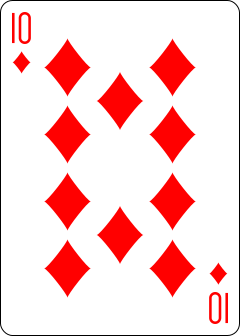
The 10♦ gives you 3 points. No other single bonus card is worth as much. An Ace or Jack gives you 1 point, and the 2♣ gives you 2.
Your move: take the 10♦ unless another play scores more right now. A sur is worth 5 points. The seventh club can secure a 7-point Haft Khâj. Taking two or three ordinary cards is not enough reason to pass on the 10♦.
We found 230 moments when a player could secure the 10♦ or choose a different legal move. Eventual winners took it 95.5% of the time. Players who lost took it 82.8% of the time.
Among those 230 choice points:
| Choice | Human wins | Human losses | Observed win share |
|---|---|---|---|
| Secured the 10♦ | 64 | 135 | 32.2% |
| Passed on the 10♦ | 3 | 28 | 9.7% |
The observed win share was 22.5 percentage points higher after players secured the 10♦. So the practical rule is simple: when the 10♦ is available, secure it unless you can point to a bigger score on the table. The 32.2% and 9.7% figures describe what happened in these games. They do not promise that one card will decide every match.
When a sur is available, clear the pool
You have two captures. One leaves a card behind. The other clears the pool. Take the sur, as long as you are not on the final deal.
Why: a sur is worth 5 points. That is more than the 10♦ and five times the value of an Ace or Jack.
Humans took the sur in 154 of 159 opportunities, or 96.9%. Before you play the first pair that adds to 11, check whether another combination empties the whole pool.
There is one exception: the final deal cannot award a sur. You still collect the cards, but you do not score the extra 5 points.
If your Jack would collect junk, save it
You can play a Jack to collect one ordinary card, or make a useful capture with something else. Use the other card and keep the Jack.
Spend the Jack when the pool pays you back with scoring cards, clubs, a large haul, or a defensive clear that denies your opponent. Do not save it by habit when your opponent can take the rich pool first.
Players had 2,297 choices where they could spend a Jack or keep it. They kept the Jack 83.6% of the time.
Ask these questions before you spend one:
- Does the Jack collect the 10♦, 2♣, or an Ace?
- Does it move several clubs into my pile?
- Can another card make a useful capture now?
- If I wait, can my opponent take the same pool first?
If the first two answers are no and the third is yes, keep the Jack. If the fourth answer is yes, waiting may cost you the table.
If two captures look close, study what remains
Suppose one move takes four ordinary cards and another takes two while leaving a safer pool. The four-card capture feels better. Our data says card count alone is a weak guide.
Players chose the largest available capture in 51.9% of the 6,288 decisions where capture sizes differed. Eventual winners chose it 51.3% of the time, while players who lost chose it 52.1% of the time. Taking the most cards did not separate the two groups.
Your move: after counting what you gain, count the threats you leave.
- Avoid leaving a pool your opponent can clear with one likely card.
- Notice whether several combinations add to 11.
- Remember that a King or Queen can block a full Jack sweep because a Jack does not collect face cards.
- If two captures score the same, prefer the pool with fewer immediate sweep routes.
Eventual winners chose the option with fewer possible next-turn sweeps 62.8% of the time. Players who lost did so 60.2% of the time. That gap is small, so use pool safety as a tie-break rather than an iron rule.
When the club race is close, count to seven
You have six clubs and can capture one more. Take the seventh club. It locks the 7-point Haft Khâj bonus.
Once either player reaches seven clubs, change your priorities. Extra clubs no longer affect Haft Khâj, though the 2♣ still carries its own 2 points. Shift your attention to surs, the 10♦, Aces, Jacks, and pool safety.
Players captured the maximum available clubs in 61.7% of choices where their legal moves offered different club totals. A pass can trade a club for a sur, a scoring card, or a safer table, so "always take the club" is too blunt.
Your move: count the clubs already captured before you price the next one.
- At six clubs, the seventh is worth the full 7-point bonus.
- Before either player reaches seven, each club advances the race.
- After seven, ordinary clubs lose their bonus value.
- The 2♣ remains worth 2 points even after the race is decided.
The tactical choices at a glance
This chart shows how often eventual winners and losers chose each tactic when their legal moves differed. The 10♦ is the strongest difference. The other rows work best as prompts for your next decision.

| When you face this choice | Default move | Change course when... | What we observed |
|---|---|---|---|
| 10♦ or another capture | Take the 10♦ | The other move makes a sur or locks the seventh club | Winners took it 95.5%; losers 82.8% |
| Sur or non-sur | Clear the pool | It is the final deal, when no sur is awarded | Humans took 96.9% of available surs |
| Weak Jack or another useful play | Keep the Jack | The pool contains points, clubs, or denial value | Humans kept it 83.6% of the time |
| Large haul or safer pool | Leave the safer pool | The larger capture banks real points | Largest haul chosen 51.9% of the time |
| Club or another scoring move | Count the race first | Haft Khâj is already decided | Maximum clubs chosen 61.7% of the time |
Your five-second decision order
When several plays look reasonable, ask these in order:
- Can I make a sur? Check every capture set unless this is the final deal.
- Can I secure the 10♦ or 2♣? Bank fixed points before ordinary card volume.
- Does this club decide Haft Khâj? Count both captured piles.
- Does my Jack earn enough? Look for points, clubs, or denial value.
- What can my opponent do with the pool I leave? Compare immediate sweep routes.
That order will not solve every hidden-card decision. It will stop you from giving away the points sitting face-up on the table.
A note on the numbers
We replayed 337 completed games and analyzed 40,560 human decisions. The direct winner-versus-loser comparisons use 120 matches against the current Quantum version, covering 14,520 human decisions. These are patterns from real play against one bot version. They show association, not proof that a single move caused the final result.
Think you can beat Quantum?
Quantum v7 has won 93 of 121 completed signed-in matches, a 76.9% win rate, through August 27, 2026. Humans have won 28.

If you consider yourself a Pâsur pro, see if you can beat Quantum. Quantum is the most advanced Pâsur bot ever created, and every game gives us another chance to study how strong players handle a hard table.
Bring the checklist. You will need it.
Play Pasur
Put it into practice
Start a free solo game against the computer, or create an account and invite a friend to your table.
Keep learning
What Is a Sur in Pasur? Sweep Rules, Points and Examples
Learn exactly what counts as a Sur in Pasur, why a Jack sweep does not qualify, how cancellation works, and when a Sur scores 5 points.
How to Practice Pâsur Solo: Getting Sharper Without an Opponent
How to practice Pâsur on your own — drills, focus areas by skill level, and what solo play teaches that table play can't. Includes how to play Pâsur online against the computer for free.
8 Common Pâsur Mistakes (and How to Stop Making Them)
The eight most common Pâsur mistakes new and intermediate players make — burning the Jack early, ignoring clubs, gifting surs — and the simple fixes that turn losses into wins.